
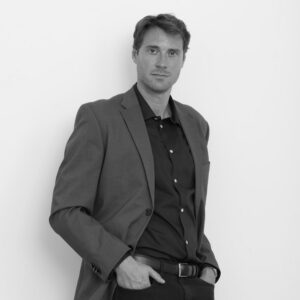
MEET CHARLES CHEMIN
The Watermill Center is pleased to announce the appointment of the French-American director Charles Chemin (b. Paris, France, 1983) as its new Artistic Director. A long-time collaborator and protégé of the late Robert Wilson, who passed away in August 2025, Chemin assumes the role as Wilson’s chosen successor, ushering in a new era for the interdisciplinary laboratory for the arts.
With a career that spans theater, dance, and opera, Chemin brings an expansive international perspective and a deep understanding of The Watermill Center’s mission. Chemin began his 33-year-long collaboration with Robert Wilson as an actor. He later became co-director and dramaturg of more than twenty Wilson works since 2009, including Mary Said with Isabelle Huppert, PESSOA with Maria de Medeiros, and Krapp’s Last Tape, in which he directed Wilson in his solo performance. Since 2020, he has served as Artistic Director of the Center’s International Summer Program.
READ AN INTERVIEW WITH CHARLES BELOW.
You’ve worked across theater, dance, opera, and performance internationally. How will your own directorial practice inform the programming and residencies at Watermill?
Diversity is a fundamental aspect of our project at Watermill, and it is at the center of my directorial practice and artistic preoccupations, in the form, the content and the approach. Working across disciplines and geographies, my practice can expand our understanding of how the arts evolve and the vast diversity of contemporary practices take shape. I am very attached to discoveries and surprises, but also to our strong relationships with art centers that shape the world’s cultural landscape. For me, these two commitments go hand in hand: experimentation is strengthened by dialogue and exchange.
Watermill’s ethos resonates strongly with this approach. It is, more than ever, a place for raising questions and engaging with the present through radical aesthetic experimentation — while also nurturing artistic growth and meaningful dialogue among artists.
What is one of your favorite performances/moments from over the years at The Watermill Center?
In nearly 35 years, there have been so many incredible artists, works, and creative moments at Watermill. A few highlights for me;
- The rehearsals for The Meek Girl, developed at Watermill in 1993 with Bob Wilson, stand out. Inviting the young artists in residence and the local community into that process was extraordinary, because it retained the raw immediacy of sharing work in progress.
- Paula Garcia’s work at our 2012 festival. She stood in armor made of magnets as participants hurled pieces of metal and boxes of nails toward her. She remained standing, despite the visible and heavy accumulation of aggression.
- I think of powerful juxtapositions in recent years: the internationally acclaimed Guatemalan artist Regina Galindo seated in a police car slowly dismantled by mechanics over the course of several hours, while elsewhere on the property fluorescent bodies moved across the acres, activating the landscape as a stage in a work by the emerging Lithuanian choreographer Dovydas Strimaitis.
You collaborated with Robert Wilson for more than three decades. How does that long creative dialogue shape the way you step into this role today?
Beyond the inspiration of his work and his distinctive approach to composition, I have been profoundly shaped by Bob’s use of space and time in all things. Everything becomes a question of distance or perspective, and to treat time as something that can be formed allows one to grasp the world and the arts in a more expansive way.
What question feels most urgent to you right now?
A world without contrast is not worth living in. We urgently need to address some questions, like the growth of younger generations, and the future more generally, with all its challenges. But we also need to not forget that inspiration comes from looking at others, that we are not alone, that we can form communities. The Watermill community is now quite large. We should lean on that. There is also a particular value in considering the revolutions of forms that happened in the arts to inform tomorrow’s evolutions.
Outside of rehearsal rooms and studios, what feeds your creativity — a ritual, a book you return to, a place you escape to?
My rhythm is quite intense. Every few months, I feel the need to go back to my house in the South of France, walk in the vineyards and fields, and write from my window overlooking the Lubéron valley while hearing the birds and kids playing below.
What is your favorite spot on the East End?
My favorite spot is an East End classic: walking on the beach! Walking on the beach anywhere on the South Fork regenerates me. The horizon above the ocean and another horizon of endless sand left and right creates for me a bubble of infinity.